Two people eat the same 10 mg THC gummy. One feels almost nothing. The other is on the couch for five hours. Same product, same labeled dose, completely different outcomes.
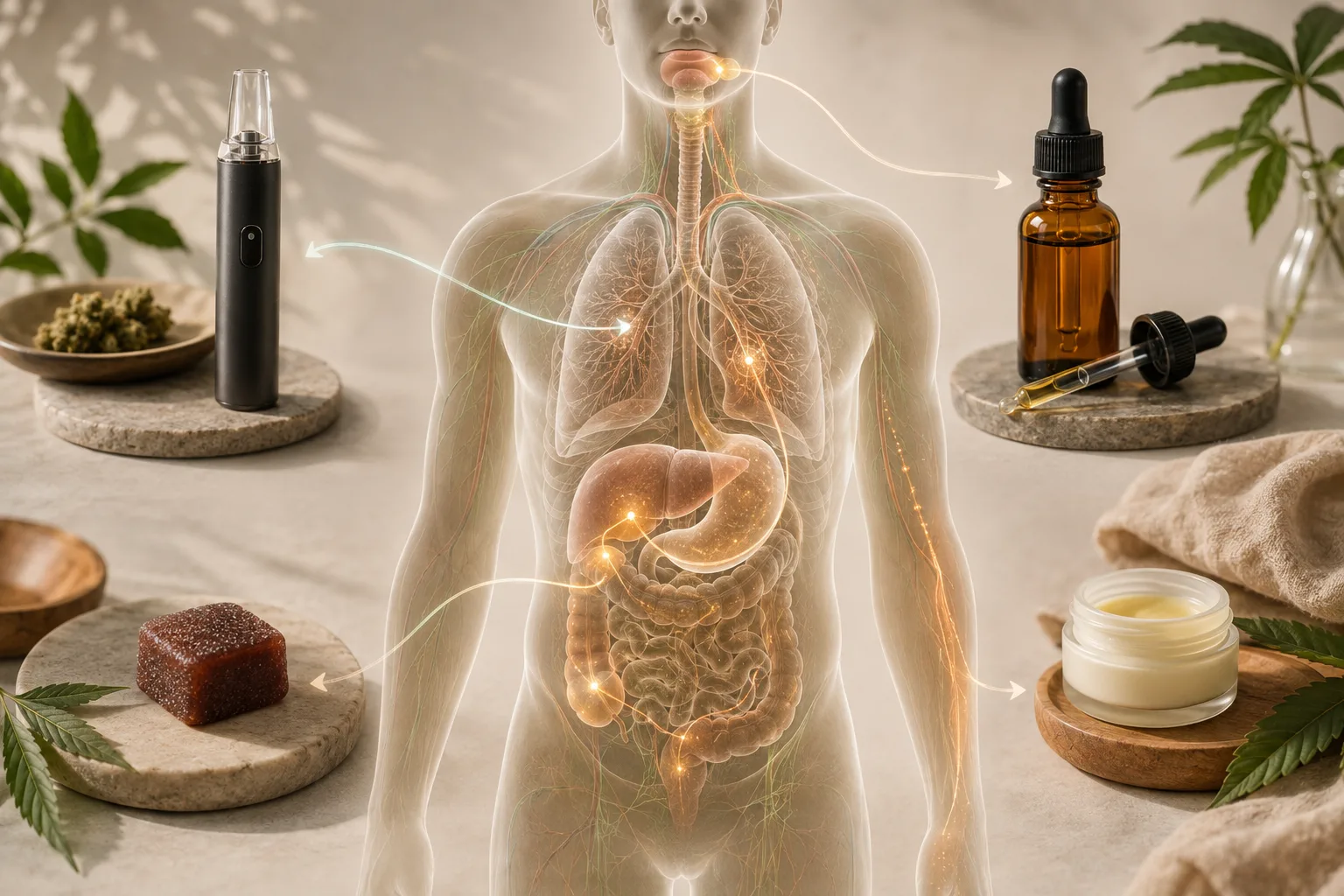
That isn’t necessarily random, and it doesn’t automatically mean the product is defective. It comes down to cannabis bioavailability: the science of how much THC or CBD from a dose reaches your bloodstream, how quickly it gets there, how the body metabolizes it, and how the consumption method changes the entire experience.
Understanding cannabis bioavailability is not just academic. It explains why a budtender may ask how you prefer to consume before making a recommendation. It’s also why switching from edibles to a vape pen, or from a tincture to a capsule, can feel like switching to an entirely different product even when the labels show similar milligram amounts.
The package tells you how much THC or CBD is in a product. Bioavailability helps explain how much reaches circulation, how quickly you may feel it, and why the experience can vary from person to person.
What Cannabis Bioavailability Actually Means
Bioavailability is the proportion of a substance that reaches systemic circulation after you take it. For cannabis, it refers to how much of the THC or CBD in a product makes it into the bloodstream.
That definition is useful, but it’s not the whole story. Four terms are often treated as if they mean the same thing:
| Term | What it means |
| Bioavailability | How much of a dose reaches systemic circulation |
| Onset | How long it takes before effects begin |
| Peak | When effects or blood concentrations are strongest |
| Duration | How long effects may last |
A route with faster absorption does not automatically produce a longer-lasting experience. A slow-onset product is not necessarily weak, either. The route of administration changes the timeline, the amount absorbed, and the way the body processes cannabinoids. Research on cannabinoid pharmacokinetics and pharmacodynamics shows that those differences can be substantial across inhaled, oral, and oral-mucosal products.
THC and CBD are highly lipophilic, meaning they dissolve more readily in fat than water. That affects how they behave in the digestive tract, why food can change oral absorption, and why oils, emulsions, and other specialized formulations are common in cannabis products. A systematic review of CBD pharmacokinetics examines how route of administration, food, and formulation affect CBD exposure.
Inhalation: Fast Onset, High Variability
Smoking and vaping deliver cannabinoids through the lungs. This route acts quickly because THC and CBD can move from lung tissue into the bloodstream without first passing through the digestive system.
Inhaled THC and CBD can reach peak plasma concentrations within approximately 3 to 10 minutes. That fast rise is why inhaled cannabis tends to provide faster feedback than an edible: people generally have a better sense of where they are headed within minutes rather than hours.
Inhalation does not produce a perfectly consistent dose, however. Historic estimates for inhaled THC bioavailability often fall around 10% to 35%, and reported CBD estimates also span a wide range across studies. A review of cannabis mechanisms and pharmacokinetics notes that device type, formulation, cannabinoid concentration, heating conditions, puff size, inhalation depth, and user behavior can all affect how much THC or CBD reaches circulation.
The practical takeaway is simple: inhalation is usually the fastest option, but it’s not the easiest method to measure precisely. A single puff may feel very different depending on the device, the product, and the person using it.
Faster absorption doesn’t mean inhalation is risk-free. Smoking involves combustion and exposes the lungs to smoke and combustion byproducts. Dry-herb vaporization avoids combustion, but is not risk-free and can still expose the respiratory system to irritants. Cartridge safety can depend on the ingredients, device quality, heating conditions, and whether the product comes from a regulated source.
Edibles: Delayed, More Variable, and Often Longer-Lasting
Edibles have some of the biggest practical safety implications because they are the route most likely to lead to accidental overconsumption.
When someone eats a cannabis gummy, baked good, capsule, or beverage, cannabinoids must travel through the digestive system before reaching circulation. The gastrointestinal tract absorbs THC, and the liver processes it before it enters systemic circulation. This is called first-pass metabolism.
During that process, the liver converts some delta-9 THC into 11-hydroxy-THC, an active metabolite. That additional metabolite contributes to the different, and sometimes more intense or longer-lasting, experience people may associate with oral THC. The CDC has described how delayed oral THC effects and metabolism can contribute to serious overconsumption events.
Edibles can take from 30 minutes to 2 hours to begin causing intoxicating effects. Peak effects may come later, commonly a few hours after ingestion, and the overall experience can last longer than an inhaled session. The review Tasty THC: Promises and Challenges of Cannabis Edibles provides additional background on the delayed onset and longer time course of oral THC.
That timeline is why the classic edible mistake happens so often: someone takes a gummy, waits 45 minutes, feels little or nothing, takes another dose, and then both doses become active together later.
The safest takeaway is not to redose just because effects haven’t appeared quickly. With an unfamiliar edible, start with a low amount and give it time. Effects may begin within two hours, but the full experience can continue building after that.
Food may also change the experience. THC and CBD are fat-soluble, so meal timing and meal composition can influence oral absorption. The clearest clinical evidence comes from prescription cannabidiol: the FDA-approved Epidiolex prescribing information states that food changes CBD exposure and recommends taking the medication consistently in relation to meals. That does not mean every over-the-counter edible will behave identically, but it helps explain why an oral cannabis product may feel different from one day to the next.
Sublingual Cannabis Bioavailability: What Tinctures Can and Can’t Do
Tinctures, oral sprays, lozenges, and other products used under the tongue or inside the cheek are often positioned as the best of both worlds: faster than an edible and more discreet than smoking.
The idea is based on oromucosal absorption. THC or CBD held under the tongue or against the cheek may be absorbed through oral tissues and enter circulation without going through the same degree of first-pass metabolism as a swallowed edible. Research on cannabinoid formulations and delivery systems supports oral-mucosal delivery, particularly when products are specifically formulated for it.
But the reality is more nuanced.
Most tincture doses don’t stay entirely in the mouth. Some portion is usually swallowed, meaning that portion is absorbed through the digestive tract and metabolized more like an edible. How much is absorbed through oral tissues versus swallowed can depend on the formula, the oil or carrier, the dose size, how long it remains in the mouth, saliva, and individual differences.
That does not make tinctures ineffective. Many consumers find them convenient and practical. But it does mean a tincture should not be marketed — or used — as if it will always bypass the liver or reliably produce an inhalation-like onset. Product-specific performance matters, and research findings for one product cannot automatically be applied to every bottle labeled “sublingual.” The review Strategies to Improve Cannabidiol Bioavailability and Drug Delivery explains why CBD absorption can differ substantially across delivery systems and formulations.
Cannabis Bioavailability Through the Skin: Topicals vs. Transdermals
Topicals and transdermals are often grouped together, but they are not the same thing.
Conventional cannabis creams, balms, lotions, and salves are generally intended for localized skin application. These products are not designed to maintain consistent THC or CBD blood levels, so they should not be expected to produce the same full-body or intoxicating effects as inhaled or oral THC.
A transdermal product is different. A true transdermal patch is formulated to move an active compound across the skin barrier and into systemic circulation over time. That is technically difficult because skin is designed to keep substances out, and cannabinoids are challenging molecules to deliver through it consistently. The review The Skin and Natural Cannabinoids: Topical and Transdermal Routes explores the formulation barriers that distinguish standard topical products from purpose-designed transdermal systems.
Packaging terms like “fast-acting,” “nano,” or “transdermal” don’t guarantee reliable blood levels—always look for product-specific evidence before assuming systemic delivery.
If systemic absorption matters for your intended use, look for transparent formulation details, independent testing, and evidence the product was designed for transdermal, not just topical use.
Do Nanoemulsions Improve THC and CBD Absorption?
“Water-soluble,” “fast-acting,” and “nano” cannabis products have become common in beverages, gummies, powders, and other oral formats. The science behind the category is real, but marketing can outpace the evidence.
THC and CBD do not mix well with water. That creates a challenge for oral products because the gut is an aqueous environment, and poorly dispersed cannabinoids may be absorbed inconsistently.
Nanoemulsions use tiny droplets of cannabinoid-containing oil mixed with emulsifiers to improve water dispersion and potentially enhance absorption in the digestive tract. Lipid-based systems and other advanced delivery methods remain active areas of cannabinoid research.
Some formulations may produce a faster onset or different absorption profile than conventional oil-based edibles. But no one should assume every product labeled “nano” delivers the same result.
How Bioavailability Affects Cannabis Dosing in Practice
The most useful lesson from cannabis bioavailability is that a labeled milligram amount does not translate neatly from one format to another.
A 10 mg edible is not pharmacologically equivalent to a product’s listed 10 mg inhaled amount. An edible goes through digestion and liver metabolism. An inhaled dose reaches circulation more quickly. A tincture may be absorbed partly through the mouth and partly through the digestive tract. A topical may not be designed for systemic exposure at all. Cannabinoid pharmacokinetic research and edible cannabis research make clear that delivery route substantially changes the pharmacokinetic profile.
That is why switching formats deserves caution.
If someone is used to inhaled cannabis and tries an edible, the delayed onset and longer duration can be surprising. If someone is used to edibles and tries a vape, the quick onset may make the experience feel very different, even if the package suggests a similar cannabinoid amount.
A few practical principles apply across methods:
- Start with a lower amount when trying a new product or changing formats
- Do not assume milligram amounts are directly interchangeable across inhaled, oral, oral-mucosal, and topical products
- Give oral products time before considering more, especially edibles
- Expect food, formulation, tolerance, metabolism, medications, and individual biology to affect the result
- Buy from regulated sources where available, and review product labels and testing information
Cannabis absorption is personal. Age, body composition, liver metabolism, tolerance, meal timing, product formulation, and concurrent medications can all change the outcome.
No single consumption method is best for everyone. Inhalation is generally the fastest. Oral products tend to last longer but can be unpredictable. Oromucosal products may offer a middle ground, depending on the formula and how they’re used. Topicals and transdermals serve entirely different purposes.
***Educational disclaimer: This article is for general educational purposes only and is not medical, legal, or dosing advice. THC and CBD can affect people differently and may interact with prescription or over-the-counter medications. Speak with a qualified healthcare professional or pharmacist before using THC or CBD if you take medication, have a medical condition, are pregnant or breastfeeding, or have questions about possible interactions. Follow all applicable laws and purchase cannabis products only from authorized sources where legal.