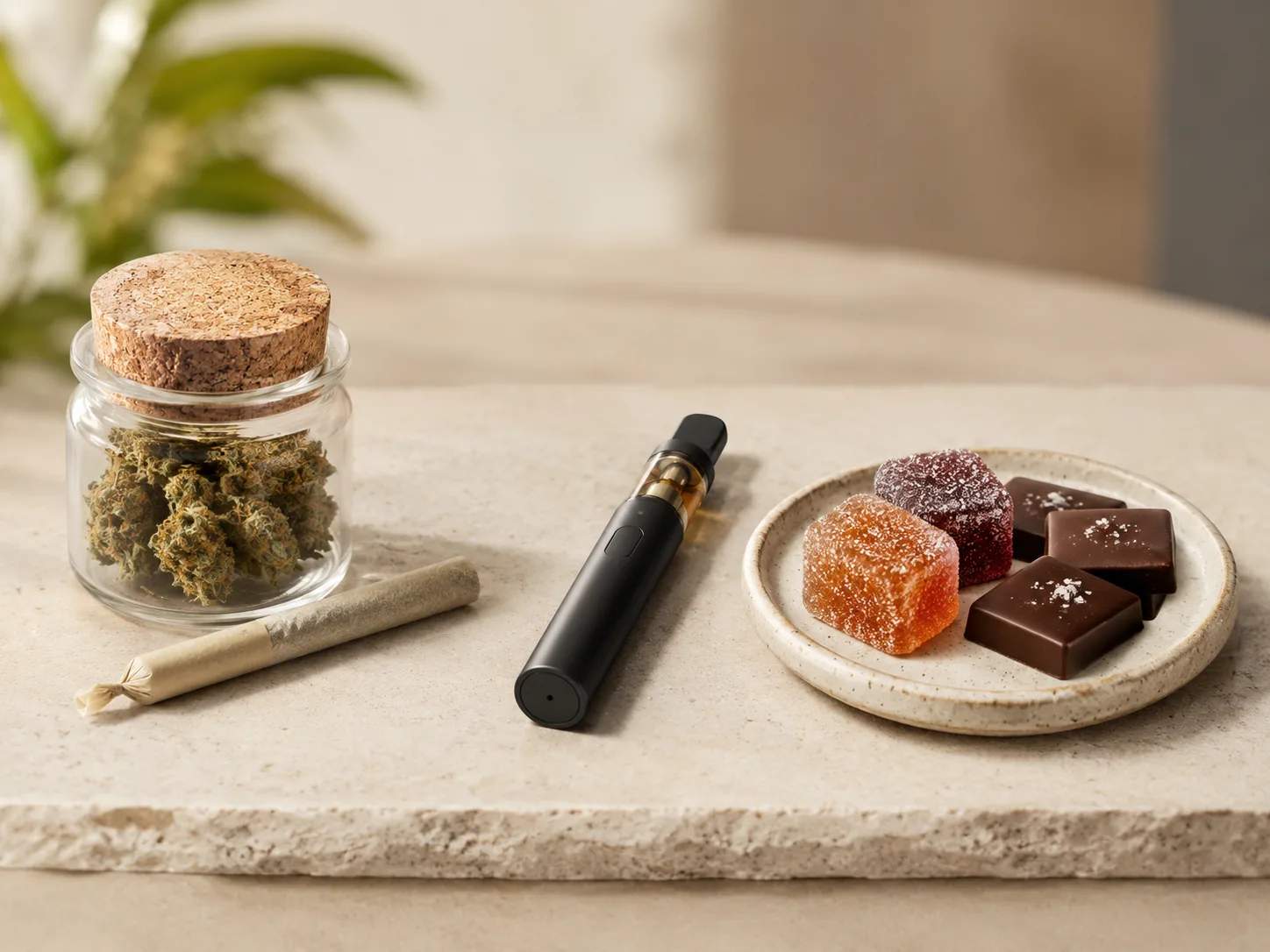
Most people pick their first cannabis consumption method based on whatever was available at the time, not because they researched it. That works until someone eats a 10mg edible expecting it to feel like a smoke session and ends up horizontal for four hours wondering what happened.
The three dominant methods of consuming cannabis produce genuinely different experiences, and the differences go well beyond how fast you feel something. Onset time, duration, intensity, discretion, dosing precision, and respiratory impact all vary significantly across smoking vs. vaping vs. edibles, and knowing those differences before you choose is what separates a good experience from a confusing one.
How Smoking Cannabis Works
Combustion is the oldest delivery method for cannabis, and it’s still the most common. When you light flower and inhale, you’re burning plant material at temperatures above 450°F and pulling a complex mixture of cannabinoids, terpenes, and combustion byproducts into your lungs. THC absorbs almost instantly through the lung tissue into the bloodstream, which is why the effects of smoking arrive within minutes, usually two to five.
That speed is one of smoking’s clearest advantages. You feel the effect quickly, which makes it easy to gauge where you are and stop before you’ve gone further than you intended. Take a hit, wait three to five minutes, and you have a reasonably accurate read on how that session is going to feel. The experience typically peaks within 20 to 30 minutes and tapers off over one to two hours.
The format also has a social dimension that vaping and edibles don’t fully replicate. Passing a joint or a bowl has a ritual quality that many cannabis users consider part of the experience. If that’s meaningful to you, it’s worth naming as a factor, and it’s not irrational to value the ceremony of something alongside its effects.
Pre-rolls and joints are the most accessible smoking format, but the experience varies based on what’s in them. If you’re curious about the differences between pure cannabis rolls and mixed options, Phenotopia’s guide to what a spliff is covers the territory clearly.
However, the tradeoff is combustion itself. Burning organic material produces carbon monoxide, tar, and other irritants regardless of what’s being burned.
How Vaping Cannabis Works
Vaping heats cannabis — either flower or a concentrated oil extract — to a temperature high enough to activate and release the cannabinoids and terpenes, but below the point of combustion. The result is a vapor rather than smoke. No burning, no tar, and significantly fewer combustion byproducts.
The health distinction between vaping and smoking is meaningful but not unlimited. Vaping cannabis flower eliminates most of the combustion-related concerns, which is why many respiratory-conscious users have made the switch. The 2007 landmark clinical trial conducted by researchers at UC San Francisco demonstrated that cannabis vaporization produces near-zero carbon monoxide exposure and fewer respiratory symptoms compared to smoking, while delivering equivalent THC blood concentrations. This foundational study provides definitive evidence that vaporization avoids toxic pyrolytic byproducts without sacrificing therapeutic efficiency.
Vaping oil cartridges, however, is a separate conversation. The 2019 EVALI outbreak, which caused severe lung injuries in thousands of people, was traced primarily to vitamin E acetate used as a cutting agent in illicit or unregulated vape products. Legal, lab-tested cartridges from licensed dispensaries do not contain vitamin E acetate, but it remains a reason to buy vape products exclusively from regulated sources where testing is mandatory.
In terms of experience, vaping delivers effects on a similar timeline to smoking: onset within minutes, peak around 20 to 30 minutes, duration of one to two hours. The effect profile can feel slightly different, partly because vaping preserves more terpene content that high combustion temperatures destroy. Many users report a cleaner, more nuanced effect from vaping flower compared to smoking the same strain.
Discretion is another area where vaping wins. Vapor dissipates faster than smoke and produces far less odor. A vape pen fits in a pocket, produces minimal visible output, and doesn’t leave your clothes smelling like a session. For users who consume in shared living spaces or before social situations, that difference is practical.
How Edibles Work and Why They’re Different
Edibles are not a faster version of smoking. They are a fundamentally different pharmacological experience, and understanding why changes how you approach them.
When you eat a cannabis-infused food or drink, the THC doesn’t go directly to your bloodstream. It passes through your digestive system and gets metabolized by the liver, which converts delta-9 THC into 11-hydroxy-THC. That metabolite crosses the blood-brain barrier more efficiently than delta-9 THC and produces a stronger, longer-lasting effect. That is why the same milligram amount hits harder as an edible than when inhaled. You’re not just getting the THC; you’re getting a more potent version of it.
Onset time for edibles ranges from 30 minutes to two hours, depending on your metabolism, what you’ve eaten, your body composition, and the specific product. That variability drives most edible horror stories. Someone eats a gummy, feels nothing after 45 minutes, takes another, and then both doses hit simultaneously when the first one finally kicks in. The rule is straightforward: pick your dose, set a two-hour timer, and don’t touch more until it goes off.
Duration is the other major variable. Where inhaled cannabis typically lasts one to two hours, edibles commonly produce effects lasting four to six hours, and sometimes longer at higher doses. For a relaxed evening at home, that duration can be ideal. For a work night or a situation where you need to be functional by a certain time, it requires planning.
One customer who came into Phenotopia after a long break from cannabis described eating a 10mg gummy thinking it would “be like a few hits.” Four hours later, still on the couch, she understood the distinction. She came back the following week asking specifically for 2.5mg options, started there, and found a dose that worked cleanly for her. That’s the edibles learning curve in miniature, and it’s a lot smoother when you start low.
Edibles also offer the most discretion of any format. A gummy looks like candy. A chocolate square looks like chocolate. There’s no smoke, no vapor, no smell, and no equipment. For users who need to be completely private about their consumption, edibles are the obvious choice.
Smoking vs. Vaping vs. Edibles: The Key Variables Side by Side
The comparison across these three methods comes down to a handful of variables that actually matter in practice.
Onset: Smoking and vaping both deliver effects within two to five minutes. Edibles take 30 minutes to two hours.
Duration: Inhaled cannabis (both smoking and vaping) typically lasts one to two hours. Edibles last four to six hours, sometimes more.
Intensity at equivalent doses: Edibles produce a stronger effect per milligram than inhaled methods because of the liver metabolism conversion to 11-hydroxy-THC. A 10mg edible will feel more intense than 10mg worth of THC inhaled.
Dosing control: Smoking offers good real-time control because the fast onset lets you assess and stop. Vaping offers similar control. Edibles are the hardest to adjust mid-session because of the delayed onset, but the clearest in terms of labeled milligrams per serving.
Respiratory considerations: Smoking involves combustion and carries respiratory risks with regular use. Vaping flower eliminates combustion; vaping oil eliminates combustion but requires sourcing from licensed, tested retailers. Edibles have no respiratory impact at all.
Discretion: Edibles are the most discreet, followed closely by vapes. Smoking is the least discreet in terms of smell and visibility.
Consistency: Pre-packaged edibles and vape cartridges from licensed dispensaries offer the most consistent dosing because they’re lab-tested. Flower dosing varies by strain, grind, and how you smoke it.
Choosing Based on Your Situation
The best way to consume cannabis isn’t universal. It depends on what you’re using it for, where you are, how much experience you have, and what tradeoffs you’re willing to make.
New cannabis consumers tend to do best with either low-dose edibles (2.5mg to 5mg) or smoking and vaping in small amounts with a built-in pause to assess. The fast feedback loop of inhaled methods makes overconsumption easier to avoid in real time, which is one reason new users often benefit from starting there before exploring edibles.
Health-conscious users or people with respiratory concerns have a clear path: edibles eliminate the inhalation question entirely, and vaping flower offers a substantially lower-combustion alternative to smoking for those who prefer an inhaled experience.
Medical or therapeutic users who need consistent, predictable dosing often gravitate toward edibles or vape products because the milligrams are clearly labeled on the package and remain stable across batches. The consistency is harder to achieve with flower, where potency varies between harvests.
Experienced users who know their tolerance well and want a social, sessionable experience tend to stick with smoking or vaping precisely because the effects are fast, the duration is manageable, and the format suits shared environments.
For anyone returning to cannabis after a significant break, especially if their last experience was with older, lower-potency products, the safest approach is treating your current tolerance as if you have none. Modern cannabis products, across all three formats, are considerably more potent than what was widely available a decade ago. Starting at the lowest available dose and working up from there applies equally whether you’re lighting up, loading a cartridge, or opening a gummy package.
The question of smoking vs. vaping vs. edibles doesn’t have a single right answer. It has an answer that’s right for your life, your health priorities, and what kind of experience you’re looking for. Getting clear on those things first makes the product decision considerably easier.