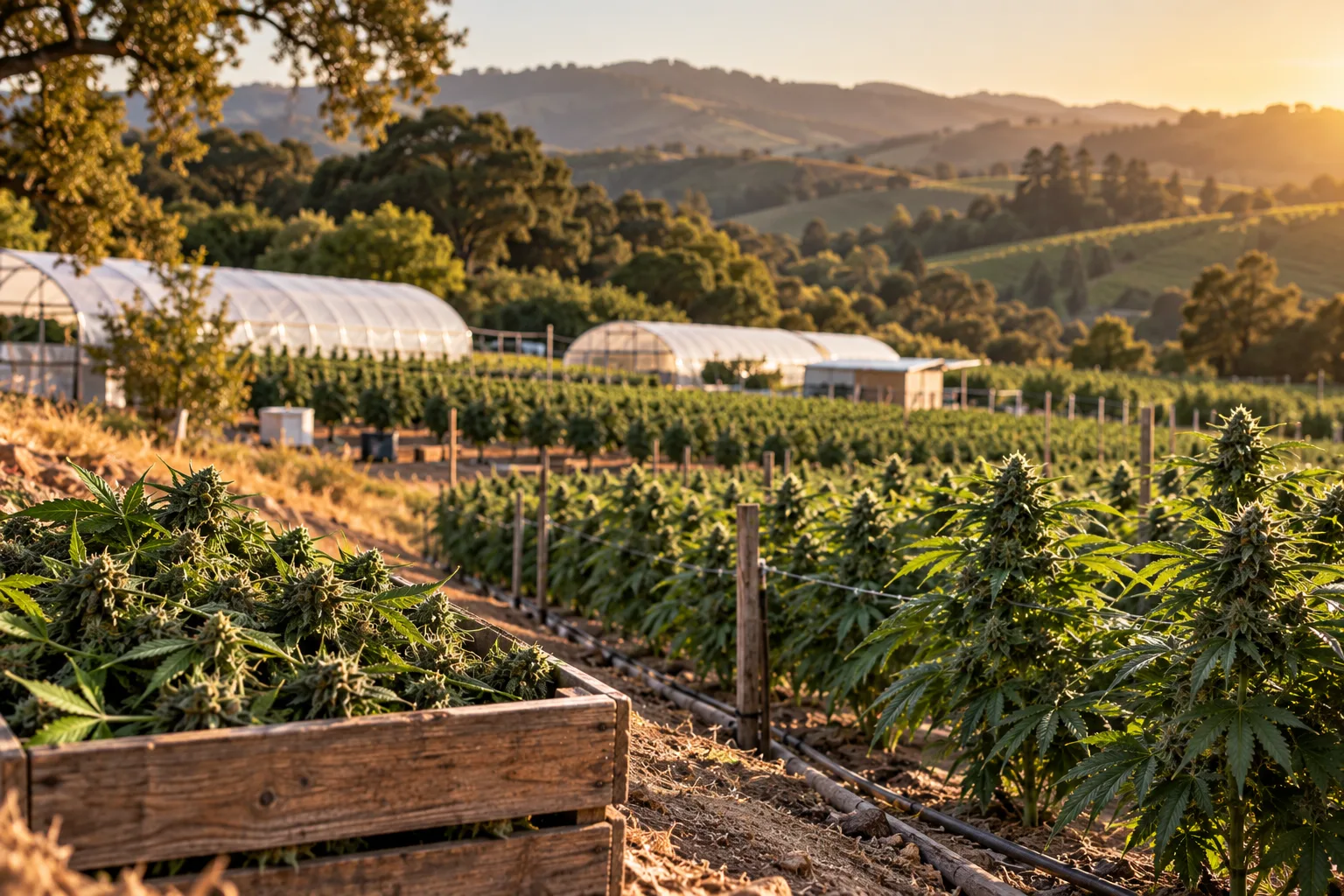
California’s legal cannabis market has continued to consolidate, with many licensed cultivators leaving the industry as prices fell and operating costs stayed high. That kind of consolidation would have flattened most agricultural sectors. A small group of permitted Sonoma County farms has continued operating through the state’s contraction, adapting to tighter margins and changing local rules.
This isn’t a piece about which farms count as officially “legacy” or how long any one operation has technically existed, since that’s a harder claim to verify than it sounds and depends on who’s doing the counting. It’s simpler than that: these are real, currently operating cannabis farms in Sonoma County, what makes the region genuinely good for growing outdoor cannabis, and how the county’s permitting rules shape who gets to keep farming here.
Sonoma County Cannabis Farms in 2026: What’s Actually Growing Here
Sonoma County sits inside California’s broader cannabis cultivation footprint, but it isn’t one of the massive-canopy counties like Santa Barbara or Humboldt. What it has instead is terroir, the same word winemakers use to describe how a specific patch of land shapes what grows on it. Sonoma County cannabis farms tend to be small to mid-sized outdoor operations that lean into that terroir rather than fighting it, which is part of why the region has built a reputation for quality over volume.
A few names come up constantly when people talk about Sonoma County cannabis growers who are still active right now. Sonoma Hills Farm, Agricola Flower and Nursery, and Luma California Farms each represent a different approach to outdoor cultivation, but all three share the same commitment to growing cannabis the way this region has always grown things: in the ground, under the actual sun, on a modest footprint.
What Makes Sonoma County Good for Growing Cannabis
The Petaluma Gap, a coastal wind corridor that cuts through the southern part of the county, pulls in cool marine air and persistent fog that famously helps thin-skinned wine grapes develop concentrated flavor. That same climate does something similar for cannabis. Cool nights, warm days, and consistent airflow reduce mold and mildew pressure while giving plants a longer, slower ripening window, which cultivators say builds denser trichome coverage and a more complex terpene profile than a rushed indoor grow can replicate.
It’s also just useful, unglamorous agricultural land. Much of the county’s cannabis cultivation happens on parcels that were previously used for cattle grazing, orchards, or other row crops, meaning the soil already has decades of organic history built into it before a single cannabis plant goes into the ground.
Inside Sonoma Hills Farm’s Approach to Craft Cannabis
Sonoma Hills Farm sits on 60 acres in the Petaluma Gap appellation, on land that was previously a cattle ranch and, before that, part of a much older agricultural history dating back to the 1850s. The farm is led operationally by Aaron Keefer, formerly the culinary gardener for the Thomas Keller Group and The French Laundry, and it holds Sun+Earth Certification along with recognition from CCOF’s OCal program, one of the first cannabis operations in the country to earn an organic-comparable certification.
What makes this a useful example of craft cannabis in practice is the deliberate slowness of it. Flower is harvested at full-term peak rather than on an accelerated schedule, and the farm treats cannabis with the same seriousness as the vegetables and herbs grown alongside it for the region’s restaurant scene. That’s a genuinely different philosophy from a warehouse operation optimizing for turnover.
Agricola Flower and Nursery: A Different Kind of Farm
Not every farm in this space looks like a wine-country showpiece. Agricola Flower and Nursery operates on a multi-acre parcel in Penngrove, led by Dr. Natasha Khallouf, and it’s also Sun+Earth Certified. Beyond cultivation, the farm has built part of its mission around increasing land access and training opportunities for underrepresented growers, which is a different kind of contribution to the local cannabis growers’ community than pure production volume. [1]
The fact that smaller boutique grows can operate alongside larger properties shows something important about this region. There isn’t one single template for what a Sonoma County cannabis farm looks like, and the county’s permitting structure allows for that diverse range of small cottage-scale cultivation up through larger permitted operations.
Luma California: Built for Hash and Rosin
Luma California Farms took a longer road to its current form. The operation was founded as a boutique cultivation project back in 2017, later expanding into Sonoma County’s Petaluma Gap region once California’s legal cannabis market matured. Their first outdoor crop went into the ground around 2020 under the guidance of Director of Cultivation Enzo Peterson. The farm is family-owned and built specifically around fresh frozen material for high-end hash and rosin production, utilizing living soil principles rather than synthetic inputs.
This kind of specialization—building an entire farm around one specific artisanal product category—is a pattern that shows up more in smaller regions like Sonoma than in the state’s biggest cultivation counties, where massive scale tends to push operations toward broader, diluted product lines instead.
How California Cannabis Regulation Reshaped the Growing Landscape
The consolidation mentioned earlier wasn’t an accident of bad luck. When California legalized adult-use cannabis, it initially issued far more cultivation licenses than the market could realistically support, and a five-year moratorium on Large cultivation licenses let well-capitalized companies stack multiple smaller licenses together instead. Add in falling wholesale prices, rising water and labor costs, and competition from the unlicensed market, and small farms across the state absorbed most of the damage. Some counties lost a meaningful share of their cultivation base within just a couple of years.
Sonoma County’s farms navigated that same pressure. Staying small and specialized, leaning on certifications like Sun+Earth or OCal to justify a premium price point, and building direct relationships with dispensaries rather than competing purely on wholesale cost all became survival strategies rather than just marketing angles.
Sonoma County’s New Cannabis Rules Taking Effect in 2026
Sonoma County’s cannabis program continued to change in 2026, including a new Cannabis Business License fee adopted April 28, 2026, and updated cannabis tax rules approved in May 2026. You can track the details directly through the Sonoma County Cannabis Program page, which the county keeps updated as ordinances change.
For anyone curious about how a small outdoor grow gets licensed here, Sonoma County fully consolidated its permitting process under Permit Sonoma on July 1, 2026. Under the modernized Cannabis Land Use Ordinance, the Department of Agriculture no longer issues land permits. Cannabis is now classified as a “controlled crop,” meaning smaller grows that comply with standard land use rules can utilize a streamlined zoning review backed by a county-wide Master Environmental Impact Report, while more complex operations still require a standard discretionary Use Permit involving public notification.
What Is Craft Cannabis and Sun-Grown Cannabis, Really?
Craft cannabis generally describes small-batch cultivation where the grower controls quality at every stage rather than optimizing purely for yield, similar to how craft beer or small-lot wine gets defined by attention and scale rather than a strict legal standard.
Sun-grown cannabis is more specific. It means the plant was cultivated outdoors under natural sunlight for its full life cycle, rather than indoors under artificial lighting or in a mixed-light greenhouse setup. Advocates argue sun-grown cannabis develops more complex terpene profiles because full-spectrum natural sunlight stimulates a broader range of cannabinoid and aromatic expressions that artificial bulbs simply cannot replicate.
Finding Cannabis Farms Near Santa Rosa
For shoppers who want to buy cannabis actually grown in the region rather than shipped in from a distant cultivation county, the most reliable approach is asking directly at the counter which flower on the shelf came from a Sonoma-based grower. Phenotopia keeps a rotating selection of locally cultivated flower specifically because that local sourcing story matters to a lot of Santa Rosa shoppers, tourists included, who want their cannabis purchase to connect back to the same wine country landscape they’re already visiting.
Common Questions About Sonoma County’s Cannabis Farms
Are there cannabis farms in Sonoma County?
Yes. Sonoma County has a range of licensed outdoor cannabis farms, from small operations under five acres to larger properties like Sonoma Hills Farm’s 60-acre site.
Are cannabis farms legal in California?
Yes, provided they hold the correct state and county licenses. Sonoma County issues both ministerial zoning permits for smaller cultivation and discretionary use permits for larger operations.
Where can I buy cannabis grown in Sonoma County?
Licensed dispensaries across the county, including Phenotopia, regularly carry flower from local growers. Asking directly at the counter is the most reliable way to confirm a product’s origin.
Sonoma County’s cannabis farms aren’t the biggest producers in the state, and they were never trying to be. What they’ve held onto is a direct relationship between the land, the grower, and the plant, which is worth knowing about the next time you’re picking flower off a shelf in Santa Rosa. Knowing a farm’s name is a small thing, but it’s the difference between buying cannabis and buying something with an actual place behind it.