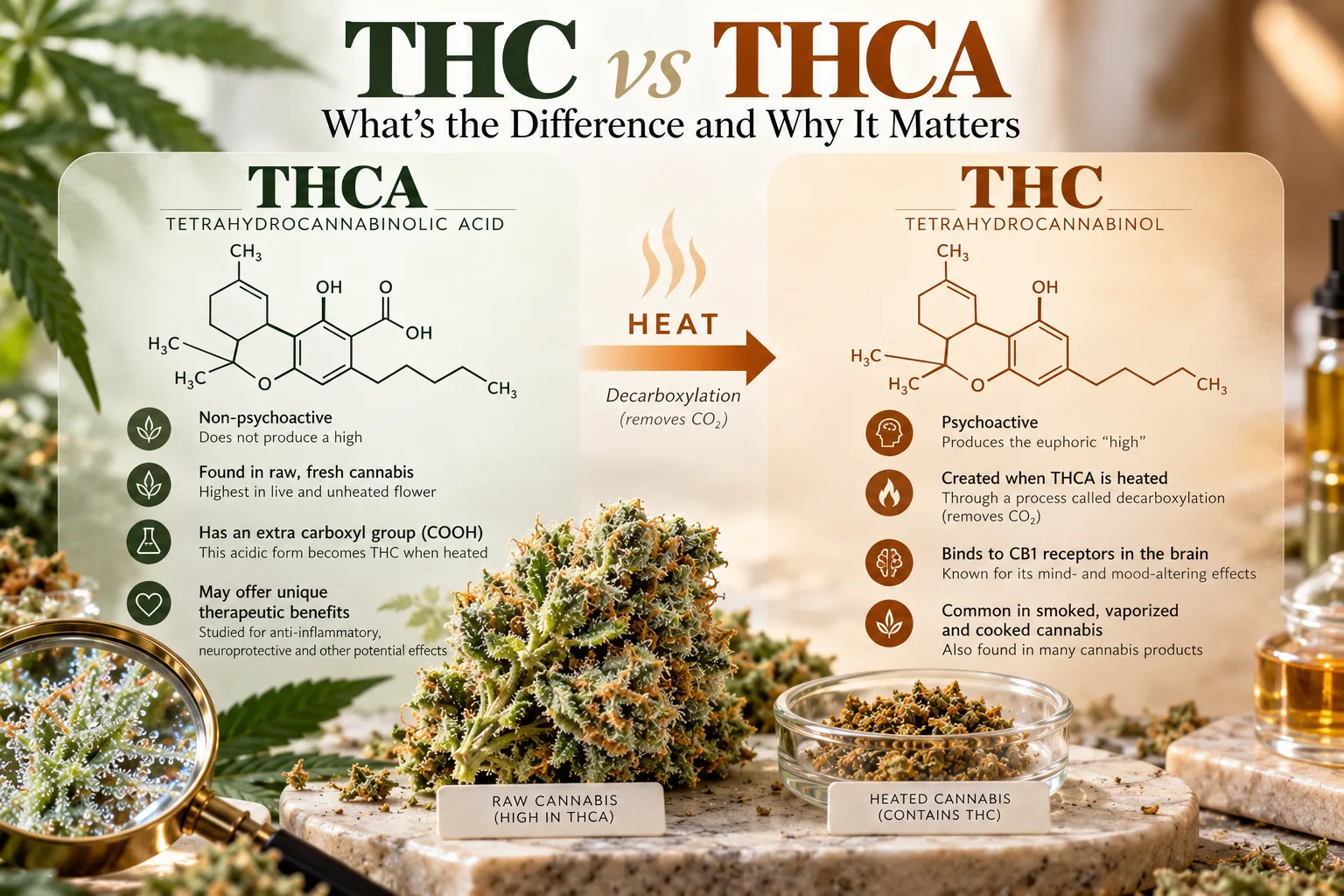
THC — delta-9-tetrahydrocannabinol — is the cannabinoid most people associate with the cannabis experience. It binds to CB1 receptors in the brain, which are part of the body’s endocannabinoid system, and produces the psychoactive effects that define what most people mean when they say they’re high. If you want a deeper look at how those receptors work and why cannabinoids affect us the way they do, Phenotopia’s explainer on the endocannabinoid system covers the underlying biology clearly.
THCA — tetrahydrocannabinolic acid — is what the cannabis plant actually produces before any heat is applied. The “A” stands for acid, and the chemical difference between THCA and THC is a single extra molecular component called a carboxyl group, made up of carbon, oxygen, and hydrogen atoms. That one addition changes the molecule’s shape enough that THCA doesn’t bind to CB1 receptors the same way THC does. A 2016 scientific review of THCA describes it as the acidic precursor to THC and confirms it does not produce THC-like psychoactive effects in raw, unheated form.
So in a freshly harvested cannabis plant, the dominant cannabinoid is THCA, not THC. A jar of flower that shows 28% THCA and 0.3% THC on its lab report isn’t weak or mislabeled. It’s accurately reflecting the chemistry of unactivated flower. The THC experience comes later, when heat enters the picture.
Decarboxylation: The Step That Changes Everything
The process that converts THCA into THC is called decarboxylation, or decarbing, in everyday cannabis conversation. Heat removes that extra carboxyl group from the THCA molecule, releasing it as carbon dioxide gas. What remains is THC, now shaped to interact with your endocannabinoid system the way you’d expect.
This happens automatically in the most common consumption methods. When you light flower and smoke it, the heat from combustion decarbs the THCA before you inhale. When you vape, the heating element does the same thing at a lower temperature without combustion. When you dab a concentrate, the hot surface converts any remaining THCA almost instantly. In every one of those scenarios, THCA becomes THC in the moment of use.
Edibles are the exception that trips people up most often. Cannabis needs to be decarbed before it’s mixed into butter, oil, or food; otherwise, much of the THCA stays THCA through the cooking process, and you end up with a product that has far less psychoactive effect than you expected. The standard home decarb method is 240°F in an oven for 40 minutes. Skip that step, and you’re essentially eating raw cannabis.
A small amount of decarboxylation also happens naturally over time as flower dries, cures, and sits in storage. That’s why a lab report on flower almost always shows some THC present alongside a much larger THCA number, even before anyone’s applied a flame to it.
How to Read the Numbers on a Cannabis Label
This is where the THCA vs. THC distinction moves from chemistry into practical shopping decisions.
When you look at a flower label or a Certificate of Analysis (COA), you’ll typically see THCA and THC listed separately. If you focus only on the THC line, you’ll dramatically underestimate the product’s potency. A flower showing 25% THCA and 0.5% THC isn’t a 0.5% product. It’s a product where almost all the psychoactive potential sits in that THCA number, ready to convert.
The useful number is total THC, calculated using a formula that accounts for the molecular weight change that happens during decarboxylation:
Total THC = (THCA × 0.877) + THC
The 0.877 factor exists because THCA is heavier than THC. When the carboxyl group leaves during decarboxylation, the molecule loses mass. A THCA molecule weighs approximately 358.48 atomic mass units; THC weighs approximately 314.47. Divide those two numbers, and you get 0.877 — the fraction of THCA’s weight that converts into THC.
Using the example above: 25% THCA × 0.877 = 21.9%, plus 0.5% THC already present = 22.4% total THC. That’s a meaningfully different read than the 0.5% the delta-9 THC line alone would suggest.
Most licensed California dispensaries either display total THC prominently or their staff can walk you through the calculation. When you’re buying from unlicensed sources, you don’t always get that clarity.
THCA Flower in Smoke Shops: What Was Actually Happening
For the past several years, a significant gray market existed around THCA flower sold through smoke shops, gas stations, and online retailers. To understand why it existed, you need a quick look at how federal hemp law worked before upcoming changes.
The 2018 Farm Bill defined hemp as cannabis with no more than 0.3% delta-9 THC by dry weight. That definition focused specifically on delta-9 THC, but it didn’t account for THCA. Growers and retailers recognized that a plant could test compliant as hemp (below 0.3% delta-9 THC) while carrying a high THCA percentage. Once that flower was smoked or vaped by a consumer, the THCA converted to THC just as it would in dispensary-sold cannabis. The experience was functionally similar; the legal classification was entirely different.
That’s the hemp loophole. THCA flower was classified as hemp before consumption, even though it behaved like cannabis during consumption. It could be shipped across state lines, sold without a cannabis license, and marketed with far fewer regulatory requirements than state-licensed dispensary products.
Public Law 119-37, as amended by H.R. 6500, changes the federal definition to count total THC — including the THCA-to-THC conversion — rather than delta-9 THC alone. While synthetic cannabinoids are banned starting November 12, 2026, the updated framework for naturally occurring cannabinoids like THCA takes effect on December 11, 2026. Under this framework, high-THCA flower that was previously legal as hemp is now classified differently at the federal level. The practical effect is that the product class that flooded smoke shops and online retailers with “legal weed” alternatives loses its federal legal basis.
State implementation and enforcement timelines vary, so the transition won’t be uniform everywhere on day one. But the legal architecture that made smoke-shop THCA flower possible is being dismantled.
Why the Source of Your Cannabis Matters More Than You Might Think
The THCA loophole conversation isn’t just about legality. It’s about what consumers actually got when they bought unregulated THCA products and what they missed compared to state-licensed dispensary products.
Licensed California dispensaries operate under the Department of Cannabis Control’s testing and labeling requirements. Every product on a licensed dispensary shelf has passed state-mandated lab testing for potency, pesticides, heavy metals, microbial contaminants, and residual solvents. The COA attached to that product is verified against those standards. When a Phenotopia budtender hands you a jar of flower, a documented chain of testing connects the farm to that jar.
Smoke-shop and online THCA products operated under hemp regulations, which have different and generally less rigorous testing requirements than California’s cannabis framework. Some products carried COAs, but COA quality and the accreditation of the labs that produced them varied considerably. Pesticide standards for hemp products weren’t equivalent to California’s cannabis testing requirements. Accurate potency labeling wasn’t uniformly enforced.
For consumers who were buying THCA flower thinking they were getting a regulated, tested product equivalent to dispensary cannabis, that assumption wasn’t always accurate. The product might have looked similar. The oversight behind it often wasn’t.
THCA vs. THC and Drug Testing
One of the most common questions that comes up around THCA is whether it shows up on a drug test differently than THC. The short answer is: it doesn’t provide the protection people sometimes assume it does.
Standard cannabis drug tests don’t test directly for THC or THCA. They detect THC metabolites, primarily a compound called THC-COOH that your body produces after processing THC. When you smoke, vape, or otherwise heat THCA flower, the THCA converts to THC before or during inhalation. Your body then metabolizes that THC and produces the same metabolites it would from any other THC source. From a drug testing perspective, THCA flower used through heat produces the same risk profile as conventional cannabis.
Raw THCA consumed without heat, like in a juice or smoothie, is a different scenario in theory, but an impractical one for most people. And even then, products typically contain some pre-converted THC from drying and curing, and testing methods and thresholds vary enough that raw consumption isn’t a reliable workaround. If a negative drug test result matters for employment, probation, athletics, or any other reason, the safest assumption is that any product containing significant THCA carries the same risk as any other cannabis product.
Is THCA the Same as THC Once You Consume It?
Chemically, after decarboxylation, yes, THCA becomes delta-9 THC. The molecule that binds to your CB1 receptors when you smoke a high-THCA flower is the same THC produced by cannabis that was always classified as cannabis. The plant’s origin, the label it wore before you consumed it, and the legal category it fell into don’t change the chemistry of what happens during combustion.
That’s the core of what made the THCA loophole both commercially successful and, ultimately, legally untenable. Consumers were getting a product that functioned like dispensary cannabis. The regulatory infrastructure around it was significantly different. Public Law 119-37 aligns the legal classification with the chemical reality.
For consumers in California buying from licensed dispensaries, this legal shift changes relatively little in practice — state-licensed cannabis has never relied on the hemp THCA loophole. What changes is the broader market that was competing alongside licensed dispensaries with fewer regulatory requirements and less testing accountability. That playing field is narrowing.
Understanding THCA vs. THC gives you a clearer read on every product you pick up, whether you’re looking at a COA for the first time, wondering why a flower label shows 0.3% THC on a product that clearly isn’t mild, or trying to make sense of the news around hemp law changes. The chemistry is the same across all of it. The context around that chemistry has just gotten a lot clearer.
If you’re still feeling a little unsure when you visit Phenotopia, don’t worry; our knowledgeable and friendly budtenders are always on hand to guide you!