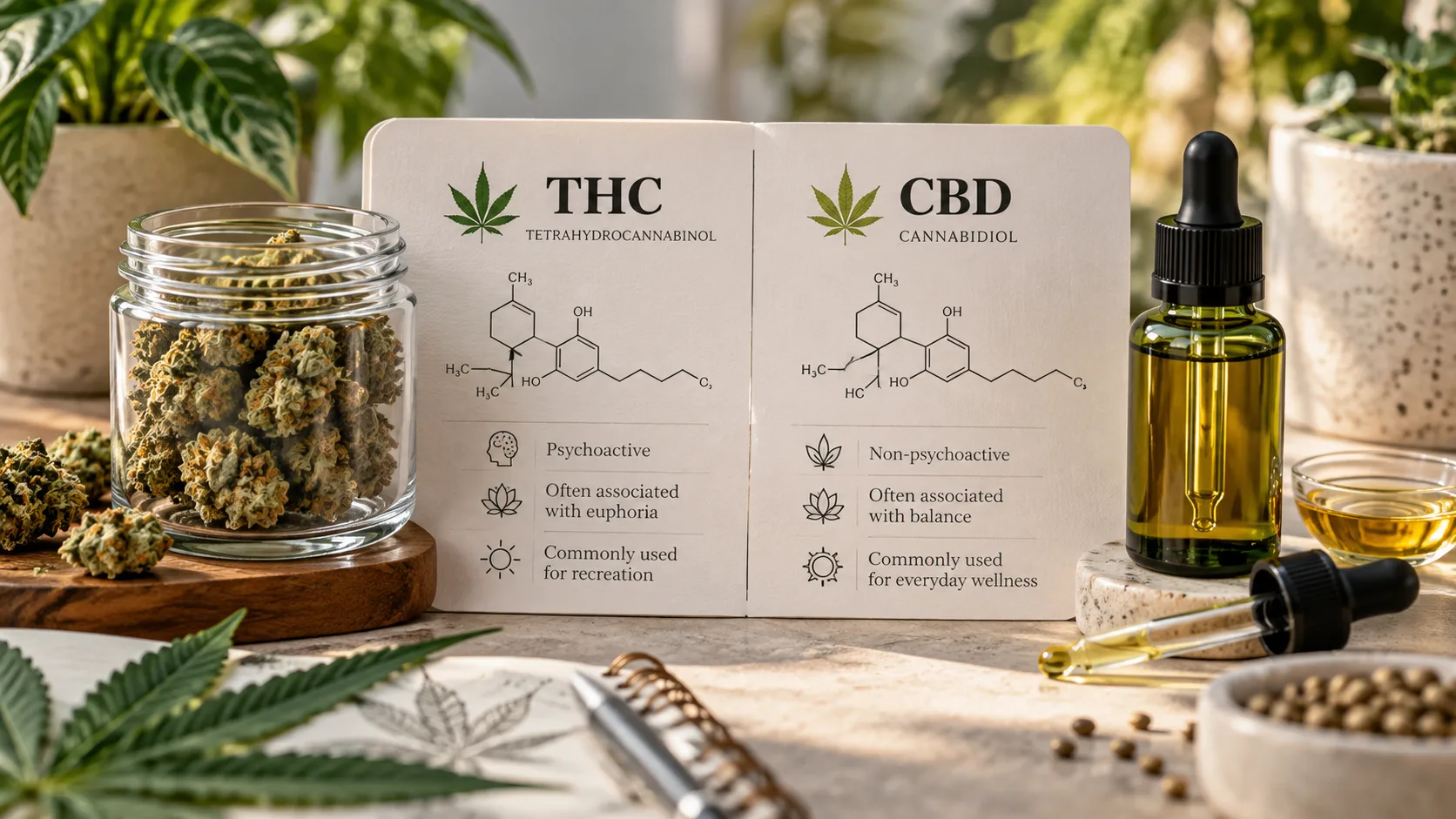
Most first-time dispensary visits start the same way: someone walks in, looks at a menu full of percentages and ratios, and realizes they have no idea what any of it means. The two letters that cause the most confusion, every single time, are THC and CBD. They appear on nearly every product label; they’re both cannabinoids from the same plant, and yet they produce entirely different experiences. Understanding that difference is the single most useful thing a new cannabis consumer can learn, and it’s genuinely simpler than the terminology makes it sound.
THC and CBD are not the same thing at different strengths. They work differently in the body, produce different effects, carry different legal implications and show up on drug tests in different ways. A 2023 review published in Frontiers in Psychiatry confirmed that THC and CBD interact with the body’s endocannabinoid system through distinct, sometimes opposing mechanisms, which is why a product with more CBD doesn’t just mean “less high”; it means something chemically different is happening.
What THC Does and Why It Gets You High
THC stands for tetrahydrocannabinol, the primary psychoactive compound in cannabis, meaning it’s the one responsible for the mental shift people describe as feeling high. It produces that effect because of how it interacts with the brain.
Your body has a built-in network of receptors called the endocannabinoid system. These receptors are distributed throughout the brain and body and help regulate things like mood, memory, pain response, appetite, and sleep. THC binds directly to a specific set of these called CB1 receptors, which are concentrated in the brain. That direct binding is what changes perception, amplifies sensory input, alters the sense of time, and produces the characteristic mental experience of cannabis.
The intensity of that experience depends on several factors: the amount consumed, the method of consumption, individual tolerance, and what else is in the product alongside the THC. A 10mg THC edible doesn’t feel the same as 25mg. Inhaling THC produces a faster, shorter experience than eating it. And THC consumed alongside CBD can feel noticeably different from THC consumed in isolation — which brings us to the second cannabinoid.
What CBD Does and Why It Doesn’t Get You High
CBD stands for cannabidiol. It’s the second most prominent cannabinoid in the cannabis plant, and it does not produce a psychoactive effect. Not a mild one. Not a subtle one. None.
The reason comes down to how it binds to receptors. Unlike THC, CBD doesn’t bind directly to CB1 receptors in the brain. Instead, it interacts with the endocannabinoid system more indirectly, influencing how the system regulates itself and engaging with other receptor types throughout the body, including receptors involved in serotonin signaling and inflammatory responses. The result is a noticeable effect, but one that stays in the physical and emotional register rather than producing the mental shift THC creates.
People who use CBD products regularly describe the experience as the absence of tension rather than the presence of a high. Physical ease, a reduced anxious edge, a slightly smoother path toward sleep- those are the experiences most commonly associated with CBD use. It doesn’t impair judgment, alter perception, or create the self-consciousness that some people experience with THC.
That distinction matters enormously for new consumers trying to decide where to start.
The Real Difference Between THC and CBD: It’s About Function, Not Strength
The most common misconception about THC vs CBD is that CBD is just a weaker version of THC. It isn’t. They’re different compounds doing different things.
THC produces a psychoactive experience by binding to CB1 receptors. CBD doesn’t bind to those receptors the same way and doesn’t produce that experience. You can’t approximate a CBD effect by taking less THC, and you can’t approximate a THC experience by taking more CBD. They’re not on the same spectrum; they’re on different spectra entirely.
The practical implication is that choosing between THC and CBD starts with knowing what kind of experience you’re actually looking for. If you want the classic cannabis experience, the shift in perception, the heightened enjoyment of food or music or conversation, THC is what produces that. If you want something that takes the edge off without changing how you think and feel mentally, CBD is the more appropriate tool. And if you want elements of both, combination products exist specifically to provide that.
Does CBD Counteract THC?
This is one of the most searched questions in cannabis, and the answer is: yes, to a meaningful degree.
Research has shown that CBD moderates some of THC’s psychoactive effects when the two are consumed together. The mechanism involves CBD’s indirect interaction with CB1 receptors—specifically acting as a negative allosteric modulator. It doesn’t block THC from binding entirely, but it alters the receptor’s shape, influencing how strongly those receptors respond to it. The practical effect is that products combining THC and CBD have long been thought to produce a more balanced, less intense psychoactive experience than equivalent doses of THC alone.
This modulating effect is one of the primary reasons combination products are often recommended as a starting point for new cannabis consumers. A 1:1 THC to CBD product — meaning equal milligrams of each — typically produces a noticeably smoother experience than the same amount of THC without any CBD present. The high is real, but the edges are softer, the anxiety risk is lower, and the overall effect tends to feel more manageable.
However, recent clinical studies challenge the universality of this rule, showing that the interaction depends heavily on dosage and how the compounds are consumed. When taken orally (such as in edibles), high doses of CBD can actually inhibit liver enzymes responsible for breaking down THC. This metabolic traffic jam can significantly increase blood concentrations of THC, leading to a stronger, more intense, and longer-lasting psychoactive experience rather than a mellowed one. Furthermore, recent inhalation trials using electronic vaporizers found that adding standard amounts of CBD to THC did not noticeably reduce the subjective “high,” cognitive impairment, or anxiety reported by users.
At the end of the day, while the “entourage effect” and receptor interactions suggest that CBD can take the edge off a THC high, the results can vary quite a bit from person to person. The old idea that CBD always waters down a high is a bit too black and white. To really understand what kind of psychoactive experience you’re in for, you’ll need to factor in things like how you’re consuming it, the exact ratio of CBD to THC, and how your body personally metabolizes it all.
THC to CBD Ratios Explained
Once you understand how THC and CBD work, the ratio numbers on product labels start making sense. Crucially, the ratio only tells you the relative balance of the two cannabinoids; the milligram amounts tell you your actual dose.
- 1:1 Ratio (Equal Parts): This means equal milligrams of THC and CBD per serving (e.g., a gummy with 5mg THC and 5mg CBD). While widely considered a balanced starting point, keep in mind that when taken as an edible, CBD can alter how your liver processes THC, sometimes making the psychoactive effect last longer or feel more intense than expected.
- 2:1 Ratio (THC-Dominant): This means twice as much THC as CBD. The psychoactive effect is more pronounced than a 1:1 product, though the CBD is still present to gently influence the overall experience. This works well for consumers with some cannabis experience who want a stronger euphoric effect.
- 1:2 Ratio (CBD-Leaning): This flips it, twice as much CBD as THC. Products in this range lean heavily toward physical relaxation with just enough THC to create a mild psychoactive buzz. It is a comfortable entry point for someone transitioning from pure CBD into THC products.
- 20:1 Ratio (CBD-Dominant): This means the product is overwhelmingly CBD, with only trace amounts of THC. These are used almost exclusively for clear-headed wellness like stress reduction or sleep support with virtually no psychoactive effect for most people. Most hemp-derived CBD products sold online or in standard retail stores fall into this territory.
Understanding these ratios turns a confusing label into a practical decision tool. Always look at the total milligrams first to set your baseline dose, then use the ratio to customize how that dose will feel.
THC or CBD for Sleep
Sleep is one of the most common reasons customers walk through our dispensary doors. But when it comes to choosing between THC and CBD, how do you know what actually works? Let’s break down the science so you can find the right product for your bedside table.
Think of THC as your short-term sleep tool. In low to moderate doses, THC is great at cutting down the time it takes to drift off and giving you that heavy, deeply relaxed physical sensation.
The catch: If you take very high doses or rely on THC every single night, it can mess with your sleep quality over time. Specifically, heavy THC use can shorten your REM sleep (the deep dreaming stage your brain needs to process memories and emotions). It can also cause “rebound insomnia,” where it’s even harder to sleep if you suddenly stop taking it.
CBD doesn’t knock you out like a traditional sleeping pill. Instead, it works in the background by quieting a racing mind, easing daytime anxiety, and melting away the physical tension keeping you awake. Because it targets the stress that prevents you from falling asleep, it’s an excellent, sustainable option for nightly use that won’t ruin your REM cycles.
For most people, the ultimate sleep aid is a product that combines both cannabinoids, usually leaning heavily on CBD, like a 1:2 or 1:4 THC-to-CBD ratio. This introduces just enough THC to relax your body without giving you a heavy psychoactive high or causing morning grogginess.
But don’t assume more CBD is always better. A fascinating clinical study published in the Journal of Sleep Research tested a high-dose oral mix of 10mg THC and 200mg CBD on adults with insomnia. Surprisingly, the study found that this massive dose of CBD didn’t protect the users’ sleep architecture; it actually shortened their total sleep time by about 25 minutes and reduced their REM sleep. This happens because huge amounts of oral CBD can slow down your liver’s ability to break down THC, making the THC hit your system much stronger and longer than expected.
When it comes to cannabis and sleep, less is often more.
- If you want a balanced, restful night without the morning fog, look for low-dose edibles or tinctures with a high-CBD, low-THC ratio.
- Start with a small dose (like 2mg to 5mg of THC) about an hour before bed, and see how your body responds.
Will CBD Show Up on a Drug Test?
This is a critical practical question, and the answer requires more nuance than a simple yes or no.
Standard cannabis drug tests don’t screen for CBD itself. They screen for THC metabolites, specifically a compound called THC-COOH, which the body produces as it processes THC. If you consume pure CBD with no THC present, you won’t generate those metabolites, and a standard drug test won’t detect it.
The complication is that most CBD products are not completely THC-free. Full-spectrum CBD products retain the full range of cannabinoids from the plant, including trace amounts of THC, typically under 0.3% by dry weight for hemp-derived products, but present nonetheless. With regular use, even trace THC can accumulate and potentially trigger a positive result.
Broad-spectrum CBD products are processed to remove most THC, but small amounts can remain. CBD isolate products containing only CBD with all other cannabinoids removed are the safest option for anyone facing drug testing, though no product can guarantee a negative result with complete certainty given the variability in individual metabolism and test sensitivity.
If drug testing is a genuine concern for your employment, probation, athletics, or any other situation, the safest practical approach is to avoid all cannabis products and hemp-derived CBD products until you’ve confirmed what your specific test screens for and what threshold it uses.
Which Should a Beginner Try First: THC or CBD?
The answer depends on what you want from the experience, and there’s no wrong choice, only the right fit for where you are right now.
Start with CBD if: You’re curious about cannabis but not ready for a psychoactive experience. You’ve had anxiety with cannabis before. You’re exploring for sleep, stress, or physical comfort without wanting any mental alteration. You’re in a situation where drug testing is a concern, and you want to use a CBD isolate product to minimize risk.
Start with low-dose THC if: You specifically want the classic cannabis experience. You’ve used cannabis before and have some sense of your tolerance. You’re comfortable with a mental shift and want to explore what that actually feels like in a controlled, intentional way. The standard starting point for THC beginners is 2.5mg to 5mg in edible form, with a two-hour wait before adding more.
Start with a 1:1 combination product if: You want a psychoactive experience but are nervous about it feeling overwhelming. You’ve tried THC before and found it too intense. You want a more balanced entry point. The CBD in a 1:1 product gives you a meaningful buffer without eliminating the THC experience; it just rounds the edges.
At Phenotopia, the budtenders field these questions daily and are genuinely good at helping people land on the right starting point without making it feel like a test. Tell them what you’re hoping to feel, what you’re hoping to avoid, and whether drug testing is a consideration — those three pieces of information are usually enough to narrow it down to two or three products worth considering.
The most important thing to take away from the THC vs CBD comparison is that neither is inherently better. THC and CBD are different tools for different purposes, and understanding that difference makes every purchase after this one more likely to give you what you came in for.