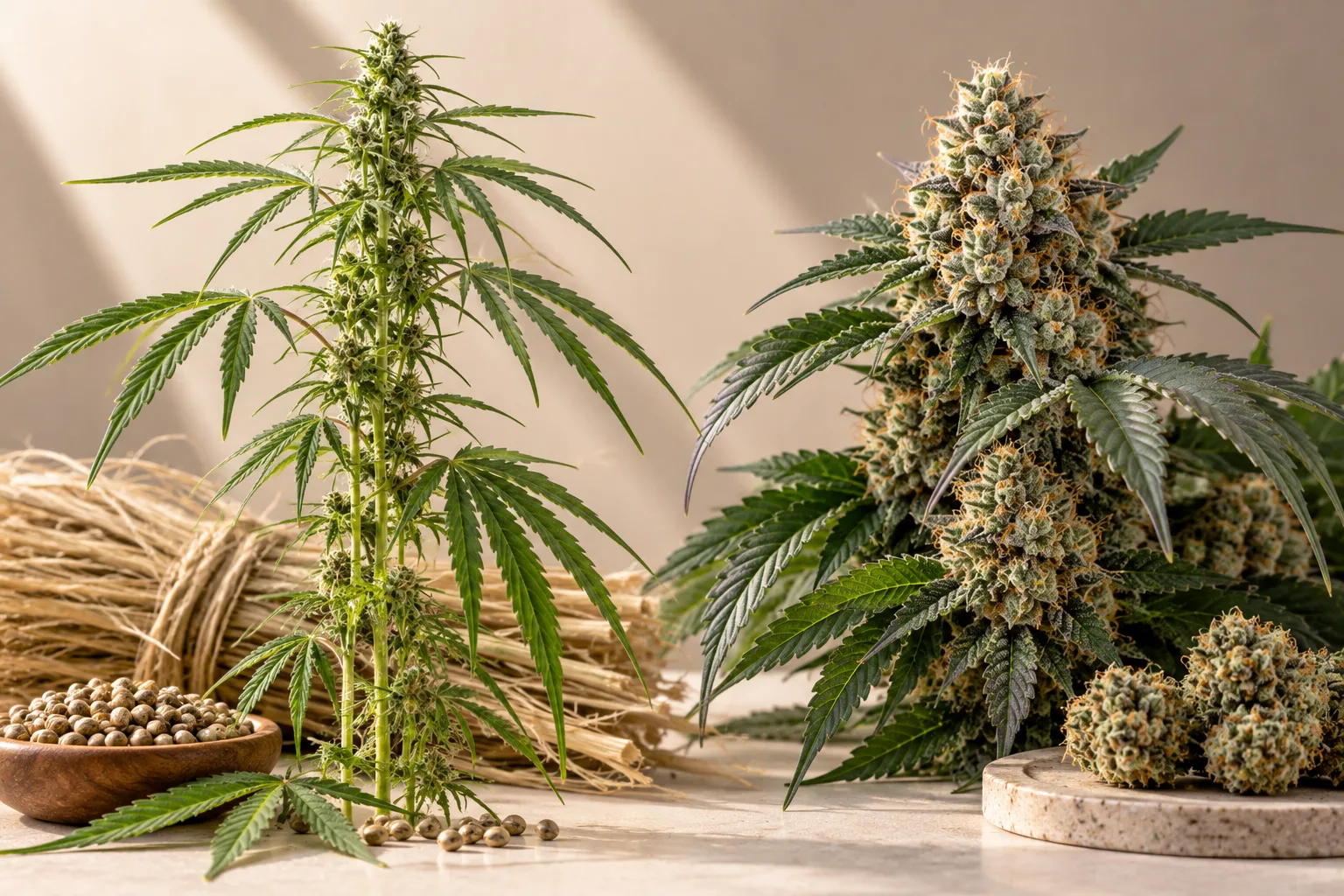
The USDA reported that the value of U.S. hemp production reached $739 million in 2025, up 64% from the year before, and most people who saw that headline still couldn’t tell you what actually separates hemp from marijuana. That gap between a booming industry and basic public understanding is exactly why the hemp vs. marijuana question keeps showing up in search bars every single day.
Here in Sonoma County, where farms and cannabis culture have grown up side by side for generations, the confusion shows up constantly at the counter. Customers assume hemp and marijuana are two totally separate species, or that CBD only comes from one of them, and neither assumption is quite right. Here’s the actual answer, along with the legal and biological details that explain why it matters.
What Is Hemp, and How Is It Different From Marijuana?
Hemp and marijuana come from the same species, Cannabis sativa, which surprises a lot of people the first time they hear it. The hemp vs marijuana difference isn’t about two different plants. It’s about how much THC that plant produces once it’s grown.
Under the 2018 Farm Bill, hemp is legally defined as cannabis containing 0.3% THC or less by dry weight. Cross that line and the same plant becomes marijuana in the eyes of federal law, regardless of how it looks or smells. Growers select hemp genetics specifically to stay under that threshold, often prioritizing fiber strength or CBD content instead of potency. In contrast, marijuana growers select for the opposite: higher THC, richer terpene profiles, and the specific effects a strain is known for.
A lot of that difference starts at the microscopic level. The resin glands called trichomes produce and store cannabinoids like THC and CBD and are found on both hemp and marijuana plants. Still, marijuana varieties are bred to produce far more of them and to load them with THC specifically. If you’ve never looked closely at why potency varies so much between plants, a look at how trichomes actually work explains a big part of the hemp vs marijuana story from the ground up, literally.
Hemp vs Marijuana: The One Line That Actually Separates Them
If there’s one thing to take away from the hemp vs marijuana debate, it’s this: the legal difference comes down to a single number — 0.3% THC. No matter how the plant looks, smells, or is grown, that threshold is the only thing that determines how it’s classified.
| Category | Hemp | Marijuana |
| THC content | 0.3% or less by dry weight | Above 0.3% |
| Gets you high? | No | Yes |
| Federal legal status | Legal under the 2018 Farm Bill | Illegal federally, legal in many states for adult-use |
| Typically grown for | Fiber, seed, CBD extraction, industrial uses | Flower quality, potency, aroma |
That threshold might look small, but it has huge consequences for farmers. A hemp crop that tests slightly over 0.3% THC due to weather stress, delayed harvest, or genetic drift is legally reclassified as marijuana, which can mean the entire crop has to be destroyed depending on the state. It’s a razor-thin margin for an entire industry to operate inside.
What Percentage of THC Makes a Plant Marijuana Instead of Hemp?
Exactly 0.3% by dry weight is the federal cutoff. Below it, a plant is hemp. Above it, regardless of intent or appearance, it’s legally marijuana. CBD content has no bearing on this classification at all, which surprises people who assume high-CBD automatically means low-risk or legally hemp.
Is Hemp the Same Plant as Marijuana?
Biologically, yes. Legally and agriculturally, no. Is hemp weed, then? Not in the way people typically mean it. Weed usually refers to intoxicating cannabis grown for higher THC, which describes marijuana rather than hemp. Hemp simply doesn’t carry enough THC to produce that effect, no matter how it’s consumed.
Are hemp and marijuana the same plant in any meaningful sense a shopper needs to worry about? Not really. Think of it less like two species and more like two branches bred toward completely different goals, similar to how a wolf and a small housedog share ancestry but live entirely different lives.
Does Hemp Get You High?
No. Hemp’s THC content stays too low to produce intoxicating effects no matter how much you use. Any calming or relaxing sensation from a hemp-derived product is generally attributed to CBD or other non-intoxicating cannabinoids, not THC.
Is Hemp Legal Everywhere in the US?
Is hemp federally legal? Yes, since the 2018 Farm Bill removed hemp from the federal controlled substances list as long as it stays under that 0.3% THC ceiling. That’s the reason hemp-derived CBD products can be sold in states that haven’t legalized cannabis for adult use at all.
Marijuana’s legal status is a different story entirely, and this is where things get genuinely confusing for people trying to follow the news. Marijuana has long been classified as a Schedule I controlled substance federally, even as a growing number of states, California included, have legalized it for adult-use or medical purposes under their own laws. But federal news in 2026 added a new wrinkle: the administration moved toward rescheduling marijuana to Schedule III, which would not legalize it federally but could ease research and tax treatment.
That patchwork between federal scheduling and state legalization is worth understanding on its own terms, and our guide to legalization versus decriminalization walks through exactly how those two concepts differ and why the distinction matters for consumers.
Hemp vs Marijuana vs CBD: The Three-Way Mix-Up
CBD adds a third layer to this whole conversation, and it trips up more people than the hemp vs marijuana question alone. CBD isn’t a plant. It’s one cannabinoid among more than a hundred that cannabis produces, and it can come from either hemp or marijuana.
Is CBD from hemp the same as CBD from marijuana? Chemically, yes, CBD is CBD regardless of the plant it came from. What changes is the surrounding profile of other cannabinoids and terpenes, along with the legal status of the finished product. CBD derived from lawful hemp is generally permitted federally, though state rules can still vary by product type and use.
CBD extracted from marijuana carries marijuana’s legal status instead, even when the isolated CBD content is identical. If you want to understand why that surrounding mix of compounds actually changes how a product feels, our breakdown of cannabinoids and terpenes covers the basics in a way that makes shopping a lot less confusing.
Why does THC or CBD do anything to your body at all? That comes down to the endocannabinoid system, a network of receptors your body already has, built to interact with cannabinoids whether they come from a hemp product or a marijuana one. Understanding how that system works explains a lot about why hemp and marijuana products can feel so different from each other despite both technically being cannabis.
What Hemp Is Actually Used For
What is hemp used for beyond CBD extraction? More than most people assume. Its fiber gets spun into textiles, rope, and paper, and processed hemp stalk mixed with lime creates hempcrete, a genuinely useful sustainable building material. Its seeds get pressed for oil or ground into flour, valued for a solid omega fatty acid profile. None of that overlaps much with what people picture when they hear the word cannabis, which is exactly why the two get treated so differently under the law.
Can You Smoke Hemp?
Technically yes, though you won’t feel high doing it since THC content is too low to produce that effect. Some people smoke high-CBD hemp flower specifically for a mellow, non-intoxicating experience, though it’s a fundamentally different experience from smoking marijuana flower.
Hemp vs Marijuana FAQs
What is the difference between hemp and marijuana?
Both come from Cannabis sativa, but hemp contains 0.3% THC or less by dry weight, while marijuana contains more. That threshold determines the plant’s legal classification.
Is hemp weed?
Not in the common sense of the word. Weed usually refers to higher-THC cannabis grown for psychoactive effects, which describes marijuana rather than hemp.
Is hemp legal everywhere in the US?
Federally, hemp is legal if it meets the THC threshold, thanks to the 2018 Farm Bill, though individual states can and do regulate specific hemp derivatives separately.
What is hemp used for?
Textiles, rope, paper, building materials like hempcrete, food products from its seeds, and CBD extraction.
Knowing the actual hemp vs marijuana difference changes how you shop, whether you’re picking up a hemp-derived wellness product at a grocery store or browsing flower with one of our budtenders here in Santa Rosa. The plant is the same family. What it’s bred to do, and what the law allows it to become, is where hemp and marijuana genuinely part ways.