Open two jars of flower with the same THC percentage, and you might smell fresh citrus in one and a fuel-like diesel funk in the other. That difference is chemistry- specifically, it’s terpenes- and understanding what they are turns the smell test from an instinct into a genuinely useful shopping tool.
Terpenes are aromatic compounds plants produce throughout the natural world. They give lavender its calming scent, black pepper its bite, pine forests their sharp freshness, and citrus peel its bright zing. Cannabis produces an unusually rich mix of them, often more than a hundred different terpenes in a single plant, and that variety is the primary reason two strains can smell and feel so different even when their cannabinoid numbers look identical on paper. Research also suggests that terpenes may interact with cannabinoids and receptors in the body, shaping the overall cannabis experience beyond just its aroma.
That makes terpenes more than a footnote on a lab report. They’re one of the most practical tools you have for choosing cannabis that actually matches what you’re looking for.
What Terpenes Actually Do in the Plant
Before terpenes were ever relevant to cannabis consumers, they were doing a job for the plant itself. Terpenes evolved as a survival mechanism: they deter pests, attract pollinators, and help the plant respond to environmental stressors like UV exposure, temperature swings, and physical damage. The same compound that gives a pine tree its sharp resinous scent helps protect it from bark beetles. The same compound that makes cannabis smell like fresh mango evolved to do something similar.
The fact that these compounds also happen to smell appealing to humans and interact with our biology in interesting ways is essentially a side effect of the plant’s original agenda. Cannabis produces an unusually diverse terpene profile compared to most plants, partly because it evolved in varied environments and needed a flexible chemical toolkit to survive them.
Terpenes form in the same trichomes that make THC and CBD, which is why a plant’s aroma profile and cannabinoid content tend to develop together. Growing conditions, harvest timing, curing method, and genetics all influence which terpenes a plant produces in what concentrations, which is also why the same strain name grown by two different farmers can smell and feel noticeably different.
What Terpenes Do in Your Body
The more interesting question for cannabis consumers isn’t what terpenes do for the plant. It’s what they do once you consume them.
Terpenes interact with the body through several pathways. Some, like beta-caryophyllene, bind directly to cannabinoid receptors; in caryophyllene’s case, specifically the CB2 receptor, making it unusual among terpenes for having a direct pharmacological role rather than just an aromatic one. Others appear to influence how cannabinoids behave once they enter the system, potentially affecting absorption, receptor binding, or how quickly effects develop.
This is the basis of the entourage effect: the widely discussed theory that cannabinoids and terpenes work better together than any single compound would in isolation. A 2019 review in Frontiers in Neuroscience examined this synergy and found evidence that terpenes can modulate cannabinoid activity through multiple mechanisms. The practical implication is that a product made from whole-plant extract retaining its original terpene profile can feel meaningfully different from a product made from isolated THC even at the same milligram dose.
This is also why the old sativa-equals-energizing and indica-equals-sedating framework has largely fallen apart under real scrutiny. The terpene profile of a given product, not its plant classification, does most of the work in shaping how it actually feels. Phenotopia’s guide to cannabinoids and terpenes covers that interaction in more depth, and the endocannabinoid system explainer is a good primer on the receptor biology behind it.
The Major Cannabis Terpenes by Flavor Family
The easiest way to start working with terpene information is to organize it by smell, because the smell a jar gives off when you open it tells you which terpenes are dominant. Here are the ones you’ll encounter most often, grouped by their aroma character.
Earthy and Musky: Myrcene
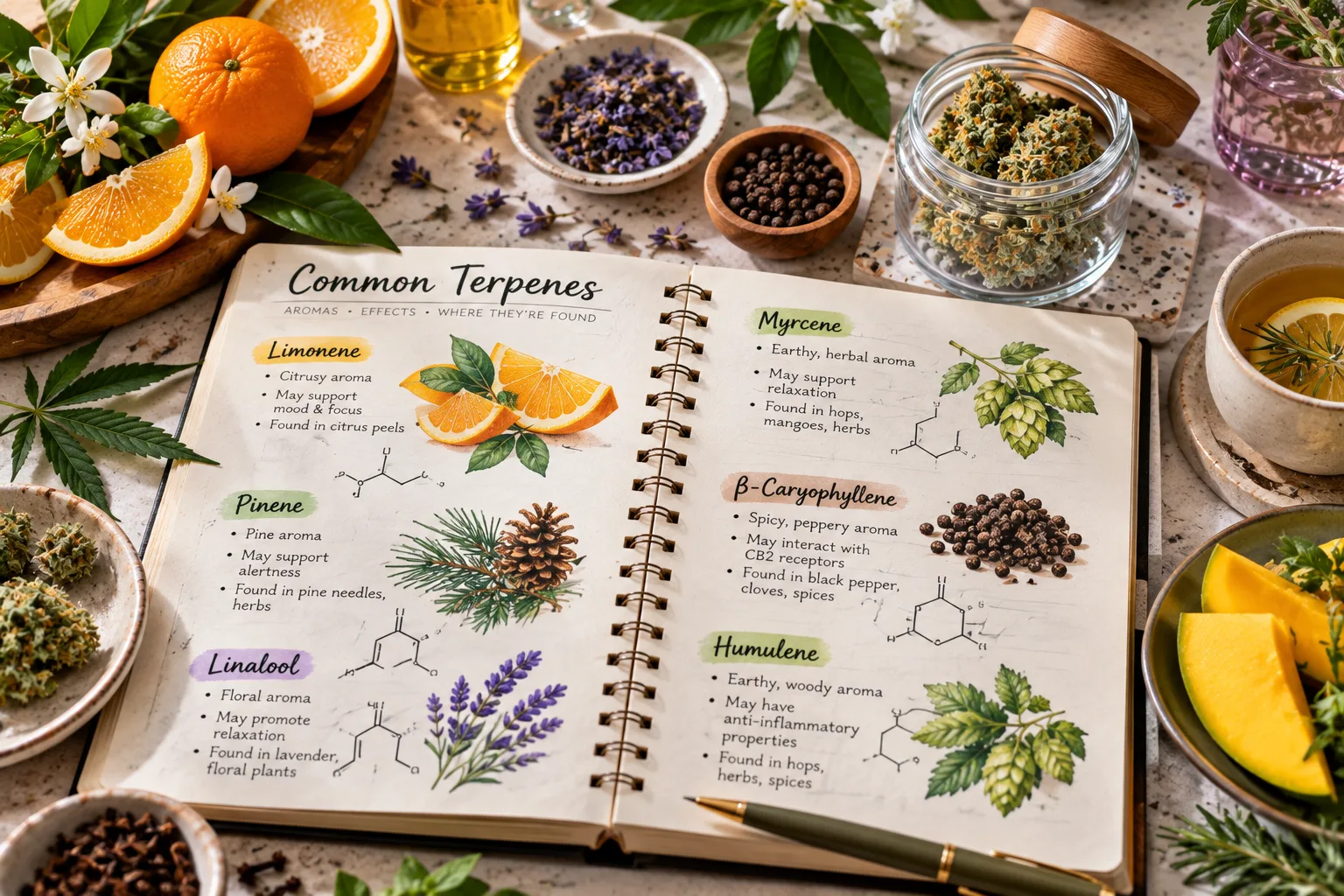
Myrcene is the most abundant terpene in commercial cannabis and the one most likely to be at the top of a product’s terpene list. Its aroma is earthy and musky with notes of ripe mango, cloves, and a slight herbal sweetness. You’ll recognize it as the warm, heavy base note underneath more complex aromas.
Myrcene is found in mangoes, hops, lemongrass, and thyme. In cannabis, products with high myrcene concentrations are consistently associated with a heavier, more physical, body-forward feeling, the kind of effect people describe as “couch-lock” at higher doses. If you’re looking for something for evening use, physical relaxation, or sleep support, products with myrcene near the top of the terpene list are a reasonable starting point.
Citrus and Bright: Limonene
Limonene smells exactly like fresh citrus peel lemon, orange, or lime, depending on the specific compound ratio. It’s sharp, clean, and unmistakably uplifting even as an aroma alone. Products dominant in limonene are consistently associated with elevated mood, reduced stress, and a more mentally engaged feeling.
Limonene is the compound in citrus rinds that makes them smell so vivid when you zest them. It’s also found in juniper, peppermint, and rosemary. In cannabis, if a product smells bright and fruity when you open the jar, limonene is almost certainly driving that character. It’s one of the most reliable terpenes to look for if you want social, uplifted, or daytime-appropriate effects.
Floral and Calming: Linalool
Linalool is the terpene that gives lavender its distinctly calming, floral scent. In cannabis, it produces a soft, slightly sweet, floral aroma that’s easy to identify once you know it. Products with prominent linalool are consistently associated with relaxation, stress reduction, and anxiolytic effects.
Linalool is found in hundreds of flowering plants beyond lavender. It’s one of the most common fragrance compounds in the natural world. In cannabis products specifically, it tends to pair with myrcene in strains designed around evening use or stress relief, adding a floral lift to what would otherwise be a purely earthy aroma profile.
Spicy and Grounding: Beta-Caryophyllene
Beta-caryophyllene smells like cracked black pepper, cloves, or a warm spice rack. It’s the terpene responsible for the slightly sharp, complex character that distinguishes certain cannabis aromas from simple sweetness. And unlike most terpenes, caryophyllene binds directly to CB2 receptors in the endocannabinoid system, giving it a pharmacological role separate from its aromatic one.
Caryophyllene is found in black pepper, cloves, cinnamon, and hops. In cannabis, it’s frequently associated with anti-inflammatory properties and a grounded, calming effect. It often appears in products focused on physical comfort or recovery, and it’s a major contributor to the complex, layered aroma of many popular strains.
Pine and Alert: Pinene
Pinene smells exactly like a pine forest: sharp, woodsy, and resinous. It’s the most abundant terpene in the natural world overall and one of the easiest to identify by smell. In cannabis, products with prominent pinene tend to be associated with alertness, mental clarity, and an energized feeling. Some research suggests pinene may help counteract the short-term memory impairment associated with THC, which would make it practically relevant at higher doses.
Fresh and Complex: Terpinolene, Ocimene, and Humulene
These three terpenes show up less consistently as dominant compounds but contribute meaningfully to complex aroma profiles. Terpinolene has a fresh, herbal, slightly floral character and is sometimes described as a mix of citrus and pine. Ocimene brings sweet, tropical, and slightly woody notes. Humulene is earthy and slightly woody, and it’s abundant in hops (part of why beer and certain cannabis strains share aromatic notes). Products with these terpenes tend to have layered, nuanced aromas that are harder to pin to a single smell category.
Why Weed Smells Like Gas or Skunk, and It’s Not Just Terpenes
Here’s the piece of terpene science that surprises most people: the classic “gas,” “diesel,” and “skunk” aromas that define some of the most sought-after cannabis aren’t primarily from terpenes at all. They come largely from volatile sulfur compounds, a chemically distinct class of molecules separate from the terpene family.
A 2021 study published in ACS Chemistry & Biology identified compounds called prenylated volatile sulfur compounds (VSCs) as the primary driver of cannabis’s distinctive skunky and fuel-like aromas. The key compound identified, 3-methyl-2-butene-1-thiol, is related to the same compound class responsible for a skunk’s spray and the “lightstruck” off-flavor in beer. It’s detectable by the human nose at concentrations as low as parts per trillion.
This matters practically because terpene-focused lab reports don’t capture VSC content. A product can have a modest terpene profile on paper while still producing an intensely gassy aroma in person. If the gas and skunk qualities are specifically what you’re seeking, smell is doing something the numbers can’t.
Do Terpenes Fade Over Time?
Yes, and this is one of the more practical things to understand about terpene preservation. Terpenes are volatile compounds, meaning they evaporate easily with heat, light, and air exposure. A jar of flower that smells intensely complex when you open it in the store may smell flatter and less interesting three months later if it’s been stored poorly.
To preserve terpene content, keep flower and concentrates in airtight containers away from direct light, heat, and temperature fluctuations. The refrigerator works well for long-term storage of concentrates. Room temperature in a dark cabinet is appropriate for flower, as refrigerating flower can introduce moisture and related problems.
The same degradation applies to production methods. High-heat extraction processes can strip significant terpene content from cannabis material before it ever reaches a product. That is why live resin—made from freshly frozen plant material rather than dried flower—is prized for terpene preservation, and why it often commands a price premium over standard concentrates. The flavor and aroma difference is real, not marketing.
The Smell Test as a Shopping Strategy
The most underused tool at a dispensary is also the most instinctive one: smell. If a budtender opens a jar and you immediately react to the aroma drawn in, curious, or even turned off you’re receiving real information about the terpene profile before you’ve read a single number.
Experienced cannabis consumers rely on smell constantly, and there’s a practical reason for it. Research on olfactory response suggests that humans tend to respond positively to aromatic compounds that work well with their individual biology. If a product’s aroma is appealing to you, there’s a reasonable chance its terpene profile aligns with something your system already responds well to.
The practical habit is this: before looking at the label, notice the smell. Then look at which terpenes are dominant and ask whether that profile matches the effect you’re looking for. Cross-reference with the cannabis glossary at Phenotopia if any terms on the label are unfamiliar. Over time, building a mental map of which terpene profiles work for you personally produces more consistent results than chasing THC percentage ever will.
Two jars can look identical on paper. Terpenes are the reason they never quite are!