You picked up a syringe of RSO from the dispensary shelf, brought it home, and now you’re looking at a thick, dark, syrup-like oil and wondering what exactly you’re supposed to do with it. That moment of uncertainty is more common than most people admit, and it matters because RSO is one of the most potent cannabis products in a licensed dispensary, and the gap between a good first experience and an overwhelming one usually comes down to understanding how to use it before you start.
RSO, short for Rick Simpson Oil, is a whole-plant cannabis extract typically testing between 60 and 90% THC. It’s named after Canadian cannabis advocate Rick Simpson, who developed the preparation in the early 2000s and distributed it widely in his community. The extraction process uses ethanol as a solvent to pull the full spectrum of cannabinoids, terpenes, and plant compounds from cannabis material, then evaporates the alcohol, leaving a concentrated, dark oil. Because it’s decarboxylated during production, the THC is already activated, making it immediately effective when ingested, unlike raw cannabis flower.
If you want more background on the extraction methods that produce RSO and how it compares to other concentrates, Phenotopia’s complete guide to cannabis concentrates covers the full landscape.
Reading Your Syringe Before You Use RSO
The syringe format exists for a practical reason: RSO is too thick to flow accurately from a dropper bottle, and it’s concentrated enough that small measurement differences produce noticeably different effects. Understanding what the syringe is telling you before you dispense anything is the most important step.
Look for two numbers on the label: total milligrams of cannabinoids in the full syringe, and milligrams per milliliter or per graduation mark. A common syringe contains 1 gram (1,000mg) of oil. If the product tests at 70% THC, that full gram contains approximately 700mg of THC — which contextualizes why the standard starting dose is so small.
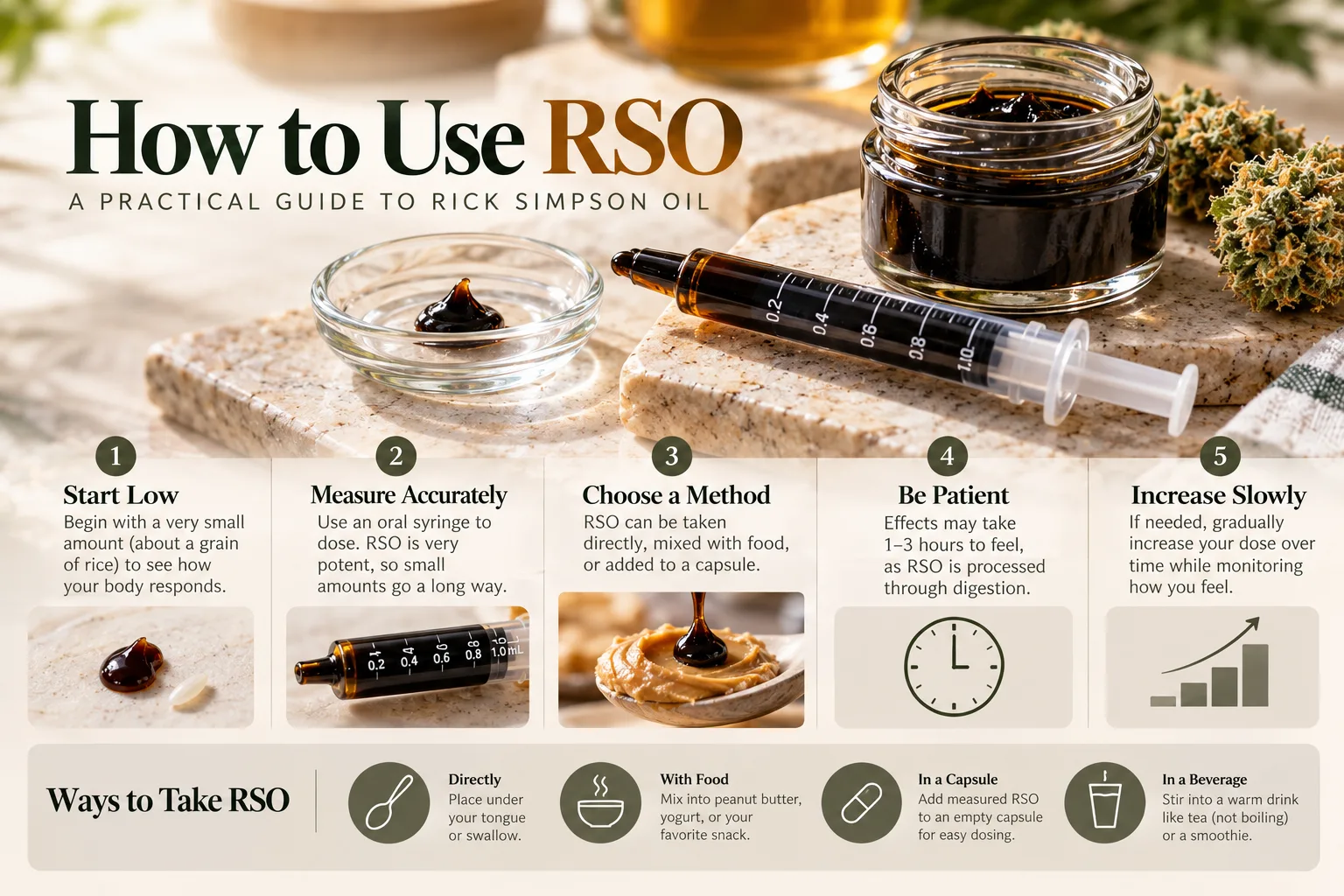
Most syringes have graduation marks along the barrel. One full graduation on a 1mL syringe typically represents about 100mg of oil. At 70% THC, that single graduation contains roughly 70mg of THC. A rice-grain-sized amount is the standard starting point for RSO beginners: about 25 to 50mg of oil total, which is well under one graduation on most syringes. That’s not an exaggeration for caution’s sake. It’s an accurate reflection of how concentrated this product is.
If the syringe is stiff and difficult to push, RSO thickens considerably when cold. Warm the sealed syringe briefly in your hands or run it under warm water for 30 seconds, and the oil will flow more easily without damaging the product.
RSO Dosage for Beginners: Start Here
The standard recommendation for anyone new to RSO is to start with a rice-grain-sized amount once daily. For most products, that translates to roughly 5 to 10mg of THC, which is still at the higher end of what most cannabis educators recommend for edible beginners, but represents the conservative end of RSO dosing.
Starting this low isn’t arbitrary. RSO is taken orally, which means the liver processes it the same way it processes any edible cannabis. The liver converts ingested THC into a metabolite called 11-hydroxy-THC, which crosses the blood-brain barrier more efficiently than inhaled THC and produces a stronger, longer-lasting effect. A dose that looks negligibly small on the syringe can produce a genuinely intense experience for someone without established cannabis tolerance.
Wait at least two hours after any starting dose before considering more. RSO onset can range from 30 minutes to two hours depending on your metabolism, what you’ve eaten, and your individual body chemistry. Taking a second dose before the first has fully developed is the most common RSO mistake, and it’s the one most likely to result in an unexpectedly overwhelming experience. The “start low, go slow” principle applies more strictly to RSO than to almost any other cannabis product format.
How to Take RSO: The Main Methods
Knowing how to use RSO also means knowing which delivery method matches your goals, since the route you choose affects how quickly you feel something and how long it lasts.
Orally on food or swallowed directly: The most common method. Dispense a rice-grain-sized amount onto a small piece of food like a cracker, a piece of bread or a spoonful of peanut butter, then eat it. Food helps mask RSO’s strong, earthy, plant-forward flavor, which differs from refined distillate products. You can also swallow RSO directly and follow it with food or a drink.
Onset for oral RSO is 30 minutes to two hours. Duration is typically four to eight hours, and sometimes longer at higher doses. Plan your timing accordingly — this isn’t a format for an evening where you need to be functional by a certain time.
Sublingually under the tongue: Place a small amount under your tongue and hold it there for one to two minutes before swallowing. The mucous membranes under the tongue can absorb some cannabinoids directly into the bloodstream, partially bypassing digestion. Sublingual absorption tends to produce a faster onset than fully swallowing RSO, sometimes noticeable within 15 to 45 minutes, while still delivering the longer duration that comes with any orally consumed portion that gets swallowed.
RSO under the tongue has a pronounced taste. If you’re sensitive to strong flavors, mixing it into food first is a more practical approach.
Capsules or gel caps: Fill an empty gel capsule with your measured RSO dose and swallow it like a supplement. This method eliminates the flavor entirely and allows for precise, repeatable dosing. It also works well for people who want the oral effects of RSO without mealtime preparation. Empty gel capsules are inexpensive and available at most pharmacies.
Mixed into food or drinks: Stir RSO into warm (not hot) food or a beverage. Because it’s already decarboxylated, you don’t need to heat it further—in fact, excessive heat can degrade THC and terpenes, so high-heat cooking isn’t recommended. Stir it into a room-temperature smoothie, mix it into yogurt, or blend it into a salad dressing. The fat content of the food you pair it with can affect absorption; cannabis is fat-soluble, so pairing RSO with something containing dietary fat may produce more consistent results.
Topically on the skin: You can apply RSO directly to the skin for localized use. Topically applied RSO doesn’t produce psychoactive effects because cannabinoids applied to the skin don’t reach the bloodstream in meaningful concentrations. This method falls outside the scope of recreational or wellness use that most dispensary consumers are looking for, and is more relevant to medical-minded users with specific applications in mind. If you’re considering topical use for a medical purpose, involve a healthcare provider in that conversation.
Can You Smoke RSO?
Technically, you can combust nearly anything, but smoking RSO is not recommended and doesn’t make practical sense. RSO is produced using an ethanol extraction process, and even trace amounts of residual solvent aren’t intended for combustion and inhalation. Beyond the safety consideration, RSO’s consistency makes it difficult to smoke effectively, and the format was never designed for that use. If inhalation is your preferred consumption method, RSO is the wrong product category. Flower, vapes, and inhalable concentrates are all better suited to that route.
How Long Does RSO Take to Kick In and What to Expect
Onset depends on your method, your metabolism, and whether you’ve eaten recently. Sublingual RSO taken on an empty stomach may be noticeable within 15 to 30 minutes. Oral RSO taken after a full meal could take up to two hours to fully develop.
The experience reflects both the product’s potency and the nature of oral ingestion. RSO produces effects similar to a strong edible: a full-body sensation, often more pronounced physical relaxation or sedation than inhaled cannabis at equivalent doses, and a longer overall window. Four to eight hours is typical. First-time users or those with lower THC tolerance may find the effects last longer.
Understanding why oral cannabis feels different from inhaled cannabis comes down to how the liver processes it. The endocannabinoid system’s CB1 receptors respond to 11-hydroxy-THC — the liver metabolite produced from ingested THC — more intensely than to inhaled delta-9 THC. Phenotopia’s explainer on the endocannabinoid system covers how those receptors work and why the same milligram amount can feel so different depending on the route.
What to Do If You’ve Taken Too Much
If you’ve taken more RSO than your tolerance can comfortably handle, the most important thing to know is that you’re not in medical danger. Cannabis overconsumption, while deeply uncomfortable, has no documented lethal dose. What you’re experiencing will pass.
In the meantime: find a comfortable place to lie down, stay hydrated, and don’t try to push through it. Eating something can sometimes blunt the peak of an edible experience. CBD has been studied for its ability to modulate THC’s effects, and taking a high-CBD product may help reduce anxiety or intensity. Black pepper contains beta-caryophyllene, a terpene with CB2 receptor activity; some people find that chewing a few peppercorns or sniffing black pepper helps manage THC-induced anxiety, though the evidence is largely anecdotal.
Most importantly, don’t take anything else while you’re waiting for the experience to pass. Adding more cannabis or any other substance to the mix will not help.
How to Store RSO
RSO’s shelf life and potency depend on how you store it. Heat, light, and air degrade THC over time, so the goal is to protect against all three.
Keep the syringe sealed between uses. Store it in a cool, dark location away from direct sunlight. The refrigerator works well for long-term storage; cold-stored RSO will thicken significantly, but a brief warm-up before use fixes that easily. Room temperature in a dark cabinet is acceptable for shorter periods.
Properly stored RSO maintains its potency for many months. The main signs of degradation are a change in color toward a more golden or amber tone (as THC converts to CBN over time) and a reduction in effect at your usual dose. If you notice either, your product has likely aged past its optimal window.
Because RSO is highly concentrated, keeping it secured and out of reach of children and pets is non-negotiable. The volume in a syringe looks small, but the THC content is significant enough that accidental consumption by a child or animal could require emergency veterinary or medical attention.
RSO for Medical Use
RSO has a strong association with medical cannabis use, rooted in Rick Simpson’s original story and the community that formed around it. If you’re considering RSO for a specific medical purpose managing chronic pain, supporting cancer treatment, addressing a neurological condition- that’s a conversation worth having with a healthcare provider before you start. Cannabis interacts with other medications, and RSO’s potency makes dosing precision more consequential than with lower-dose products.
RSO is not a replacement for medical treatment. The clinical research specifically on RSO as a preparation is limited; what exists is a broader body of research on cannabinoids and their effects on various conditions. A licensed healthcare provider familiar with cannabis medicine can help you integrate RSO into a care plan responsibly.
The cannabis glossary at Phenotopia is a useful reference for any terminology that comes up in that conversation, from cannabinoid ratios to certificate of analysis vocabulary, so that you can navigate dispensary labels and product specs with confidence.
If you’re interested in learning more about RSO and whether it’s right for you, don’t hesitate to talk to one of our friendly team members, who will be happy to guide you through the process and answer any questions you may have.